What Did the Sky Look Like on a Certain Date?
Recomputed star by star for any place and any date from the year 1 to 3000 — with the slow wobble of the Earth's axis applied, and dates before 1582 read in the Julian calendar they were written in.
See the sky for your date
Free, in your browser, with no account and nothing to buy. The SVG, the 300 dpi PNG and the PDF (a real page of the size you pick, from 21 × 29.7 cm to 70 × 100 cm) are each the complete poster.
Three inputs pin down a sky: the date, the time of night, and the place. Earth’s rotation is a precise clock and its orbit a precise calendar, so given those three facts the altitude of every catalog star follows from arithmetic — the same arithmetic whether the date is last Tuesday or fifty years ago.
This generator answers the question for the fixed stars: which stars and constellations were up, how high, and in which compass direction, drawn as a circular all-sky chart you can also caption and print.
What it can and cannot tell you
- It shows: all naked-eye stars (to magnitude 5.0), the constellation figures, the Milky Way band, and their exact placement over your horizon. The Moon is drawn as well, at its real altitude, azimuth and illuminated phase for that instant — so “was there a full moon?” is answered on the chart itself, and if the Moon had already set it is simply not there.
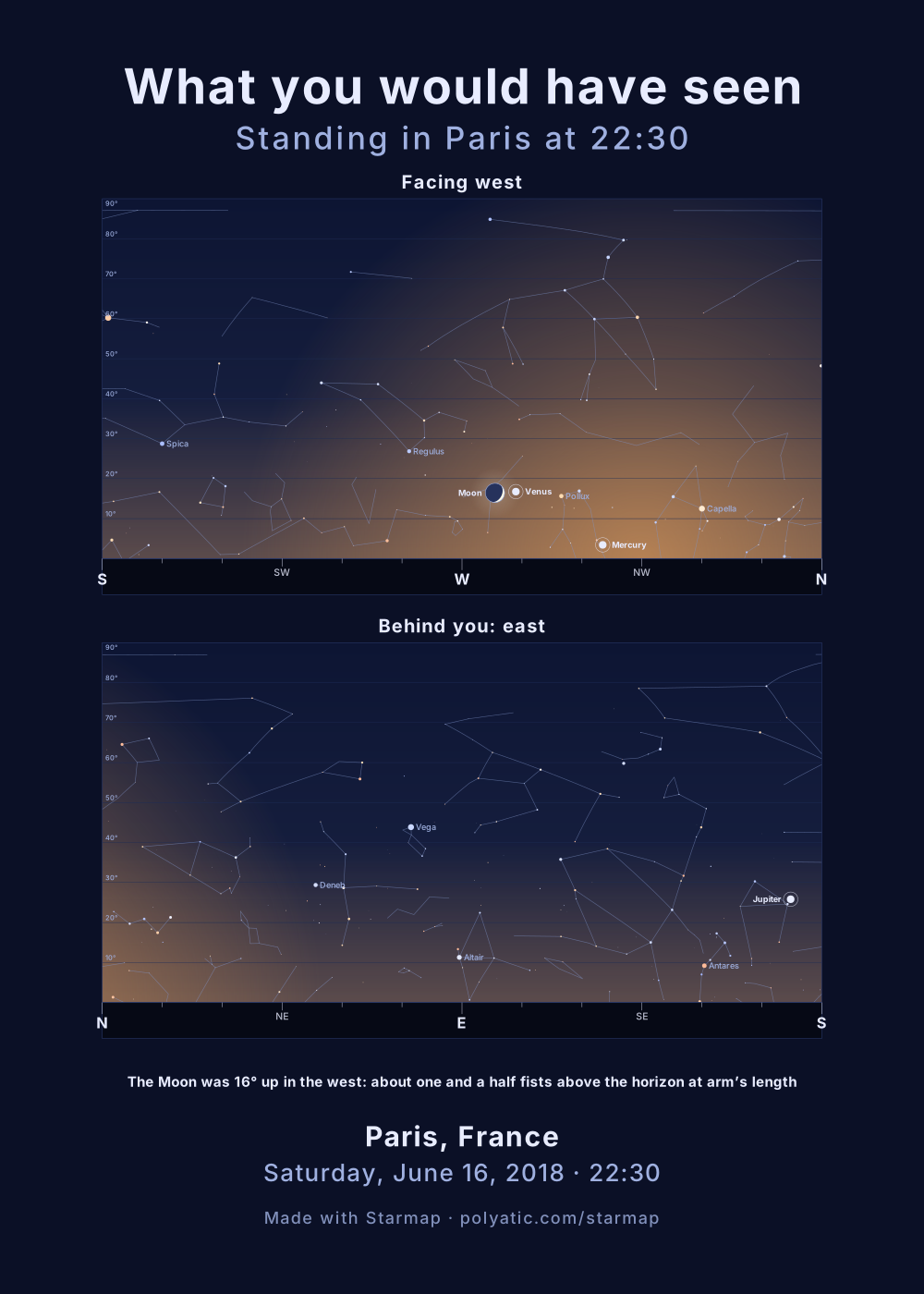
- It shows the planets too: Mercury, Venus, Mars, Jupiter and Saturn are drawn where they were, sized by how bright each was, and named, and the line under the chart lists which of them were up. Over Paris on 16 June 2018 at 22:30, for example, it puts Jupiter low in the south in Libra, and Venus beside the crescent Moon in the west.
- It shows the Sun, and says how dark it was: the Sun is drawn whenever it was up, and the line under the chart names the light at that moment — daylight, civil, nautical or astronomical twilight, or full dark — with the Sun’s altitude. At Aarhus on 18 June 1994 at 23:30 the Sun was 7° below the horizon: nautical twilight, bright enough to hide the faintest stars. Where a summer night never gets fully dark, as in Oslo in June, it says so and names the darkest minute.
- It says it in words, too: under the chart a short paragraph, with a Copy button, states what was up — the light, the Moon’s phase and where it stood, each planet’s direction, height and constellation, the constellation overhead and the brightest star. The same text is written into the downloaded SVG as its description, so the file explains itself to a screen reader. For Paris on 16 June 2018 at 22:30 it reads, in part: “A waxing crescent Moon, 13 % lit, stood low in the west in Cancer beside Venus. Jupiter was low in the south in Libra…”
- Which constellation held the Sun: the paragraph also names the constellation the Sun was really in that day, by the official IAU boundaries — and that is usually a different name from the one calendars print for the date. On 16 June 2018 the Sun was in Taurus, while calendars give that date to Gemini; from about 30 November to 18 December it is in Ophiuchus, a name calendars never use. For dates from 16 June 1995 to today it also links NASA’s Astronomy Picture of the Day for that date.
- Uranus, Neptune and 133 deep-sky objects are one switch away: tick Deep-sky objects and the chart marks all 110 Messier objects and 23 southern and binocular showpieces (Omega Centauri, 47 Tucanae, both Magellanic Clouds, the Carina Nebula and more) with star-atlas symbols and labels such as M31 and M42, and adds Uranus and Neptune — open it ticked on a winter evening, London on 24 December 2025 at 21:00, where the Orion Nebula (M42) is marked in Orion’s sword and the Pleiades (M45) and the Andromeda Galaxy (M31) are higher up. Most of them are binocular targets: only a handful, such as M31, M42, M45 and Omega Centauri, show to the naked eye from a dark site, Uranus (about magnitude 5.7) only to a sharp eye, and Neptune (about 7.8) only in binoculars.
- Eclipses are drawn: if your moment falls inside a solar or lunar eclipse seen from your place, the chart shows the Moon over the Sun, to scale, or the Moon in the Earth’s shadow, and a corner inset magnifies it twenty times. In totality the horizon view goes dark and names the planets that came out: Burgos at 20:29 on 12 August 2026 reads “Totality: the sky darkened enough to see Venus and Jupiter”.
- Great comets: tick Great comets to draw any of 21 great comet apparitions since 1900 that was up, like Hale-Bopp over London on 1 April 1997 (open it). The tail points away from the Sun; its length and shape are illustrative. Satellites and faint comets are not drawn.

What you would have seen, standing there
A round chart answers “what was overhead”. If the question is what you would have seen looking out from where you stood, pick Horizon view under Layout. On every portrait size (all the print sizes, and the phone and story formats) it draws two stacked panoramas, each 180° wide and running from the ground to straight overhead: on top the half of the sky you face (north, east, south or west), and below it the half behind you, labelled “Behind you: east” or whichever it is, so the whole horizon is on the sheet and every star that was up appears exactly once. On the Landscape, Desktop and Square formats it is a single 180° panel from the ground to 70° up. Either way it shows the stars down to magnitude 4.5, the constellation figures, and the Moon and planets at their true height, each named. Left to itself it faces the brightest thing in the sky at that moment and says which that was. The sky is tinted by the light at that minute — a warm glow low on the Sun’s side in twilight, blue by day — and a line under the picture gives the height in something you can check with your own hand: a fist held out at arm’s length covers about 10° of sky.
For Paris at 22:30 on 16 June 2018 it turns west and reads “The Moon was 16° up in the west: about one and a half fists above the horizon at arm’s length”, with Venus just to the Moon’s right, Mercury 3° up further north-west, and the sky still orange where the Sun had set 34 minutes earlier. Facing south instead, east is on your left and west on your right, exactly as when you stand there; Jupiter shows 26° up just east of due south. Limits: the horizon is drawn flat, as from open sea or a level field, so a real skyline of hills, trees or houses would hide the lowest few degrees; and each panel is to scale in both directions, which stretches shapes sideways high up (by about three times at 70°, and more the nearer they are to overhead, which on the portrait bands is the top edge).
Open the horizon view for Paris, 16 June 2018, 22:30.
Dates from history
Any year from 1 to 3000 can be drawn, and the chart is the sky of that year, not today’s sky turned to the right hour. Two things make that true. First, the Earth’s axis wobbles round once in about 26,000 years, so the celestial pole and the equinox slide 1.4° a century; every catalogue star, constellation line, the Milky Way, the Moon, the Sun and the planets are carried by one long-term precession rotation (Vondrák, Capitaine & Wallace 2011) to where they stood on your date. Second, dates before 15 October 1582 are read in the Julian calendar, the way chronicles and parish registers wrote them; a Calendar switch appears beside the date for those years, for a date a source has already converted to Gregorian, and the caption says “(Julian calendar)” so a printed chart cannot be misread.
A worked example: Battle, East Sussex, 21:00 on 14 October 1066, the evening of the Battle of Hastings. Read as the Julian date the chroniclers used, the chart gives full dark, a waning crescent Moon (44 % lit) still below the horizon, Vega halfway up in the west and Cassiopeia overhead — and the Sun that day in Libra. Precession alone has moved Vega and Deneb about 6° from where today’s catalogue places would put them that night. Read the same digits as a Gregorian date instead and you get the sky six days earlier, with a 93 %-lit Moon low in the east: the wrong night.
What is still approximate: the stars’ own proper motion is not modelled, so a handful of nearby stars sit slightly off on old dates — in 1066 Alpha Centauri about 1°, Arcturus 0.6°, and Sirius and Procyon 0.3° each from where they really stood, every other bright star less than 0.2°. The planets come from JPL orbital elements valid 3000 BC–3000 AD, whose stated worst error runs from 20 arcseconds for Mercury to about 0.3° for Saturn. The Earth’s slowing spin (ΔT, about 21 minutes in 1066) is taken from NASA’s Espenak–Meeus fits to ancient eclipse records, whose own uncertainty there is about a minute — it moves the Moon by under 0.01°. Dates after 1582 are always read as Gregorian: for an Old Style English date before 1752, add 10 days (11 after February 1700) first.
Open the 14 October 1066 chart for Battle.
What the chart draws
The chart holds the 1,630 stars brighter than magnitude 5.0 and the 89 constellation figures, and the Milky Way is drawn as a soft band. Every position is carried to your date by precession. Not modelled: the stars’ own proper motion. A date before 15 October 1582 is read in the Julian calendar. It all runs in your browser, nothing is uploaded, and the downloads are complete and free. Accuracy, print sizes and privacy, answered in full.
Common questions
Can it show the moon and planets?
The Moon, yes. It is computed from the standard truncated ELP-2000/82 lunar series and drawn at its real altitude, azimuth and illuminated phase for the exact moment you enter — and left off the chart when it was below your horizon. It is drawn where a person standing at your coordinates would see it, not where the Moon sits as seen from the centre of the Earth — those differ by up to about 1° (two Moon widths) near the horizon. The limits that remain: about 0.003° from the lunar series itself, and atmospheric refraction, which lifts objects near the horizon by up to ~0.5° and is not modelled. The planets, yes too: Mercury, Venus, Mars, Jupiter and Saturn are drawn at their real positions for that moment, sized by their brightness and labelled, and only when they were above your horizon. Their positions come from JPL's published orbital elements and match NASA/JPL Horizons to within 0.16° between 1900 and 2049. The Sun is drawn as well whenever it was above your horizon, and the line under the chart says whether that moment was daylight, twilight or full dark. Uranus, Neptune and 133 deep-sky objects, such as the Orion Nebula and the Andromeda Galaxy, are added when you tick Deep-sky objects. Satellites and faint comets are not drawn.
How can you know the sky from decades ago?
Because nothing about it was random. Earth's spin and orbit are precise clocks, and the one slow change in the background — the precession of the Earth's axis, 1.4° a century — is applied to every star, line and body for the date you enter. Recomputing a 1970 sky is the same arithmetic as computing tonight's; recomputing a 1066 sky adds 13° of precession and the Julian calendar, both handled.
Was the same sky visible everywhere on Earth that night?
No — latitude decides which stars can rise at all (Crux for the south, the Plough's circumpolar sweep for the north), and longitude plus time decide which are up right now. That's why the place is a required input.
What does it show if my moment fell during an eclipse?
The eclipse as seen from your place, in every layout. The caption says which eclipse it was and when its total or annular phase ran (or, for a partial one, how much of the Sun was covered at its peak), and a solar eclipse always comes with the eye-safety rule: never look at the Sun without certified eclipse glasses, except during totality itself. The round chart and the horizon view carry an inset that magnifies the Sun and Moon twenty times, with the Moon's disc offset by its true distance from the Sun as seen from your coordinates; for a lunar eclipse it shows the Earth's shadow on the Moon. The sky in the horizon view is a simple model, not a photograph: during the partial phases the daylight is dimmed in proportion to the share of the Sun covered (half covered, half as bright), and in totality, or with less than 1 % of the Sun left, it is drawn as deep twilight with an orange glow all round the horizon. Real eyes adapt, so a real sky changes little until about 90 % is covered and then darkens quickly. Planets are named as visible in that darkness only if they were above your horizon, brighter than magnitude 1 and at least 2° up; lower ones are lost in the glow. The Moon's edge is treated as smooth, so contact times can differ from the real ones by a few seconds.