Heart Star Map: the Sky of Your Night, Cut to a Heart
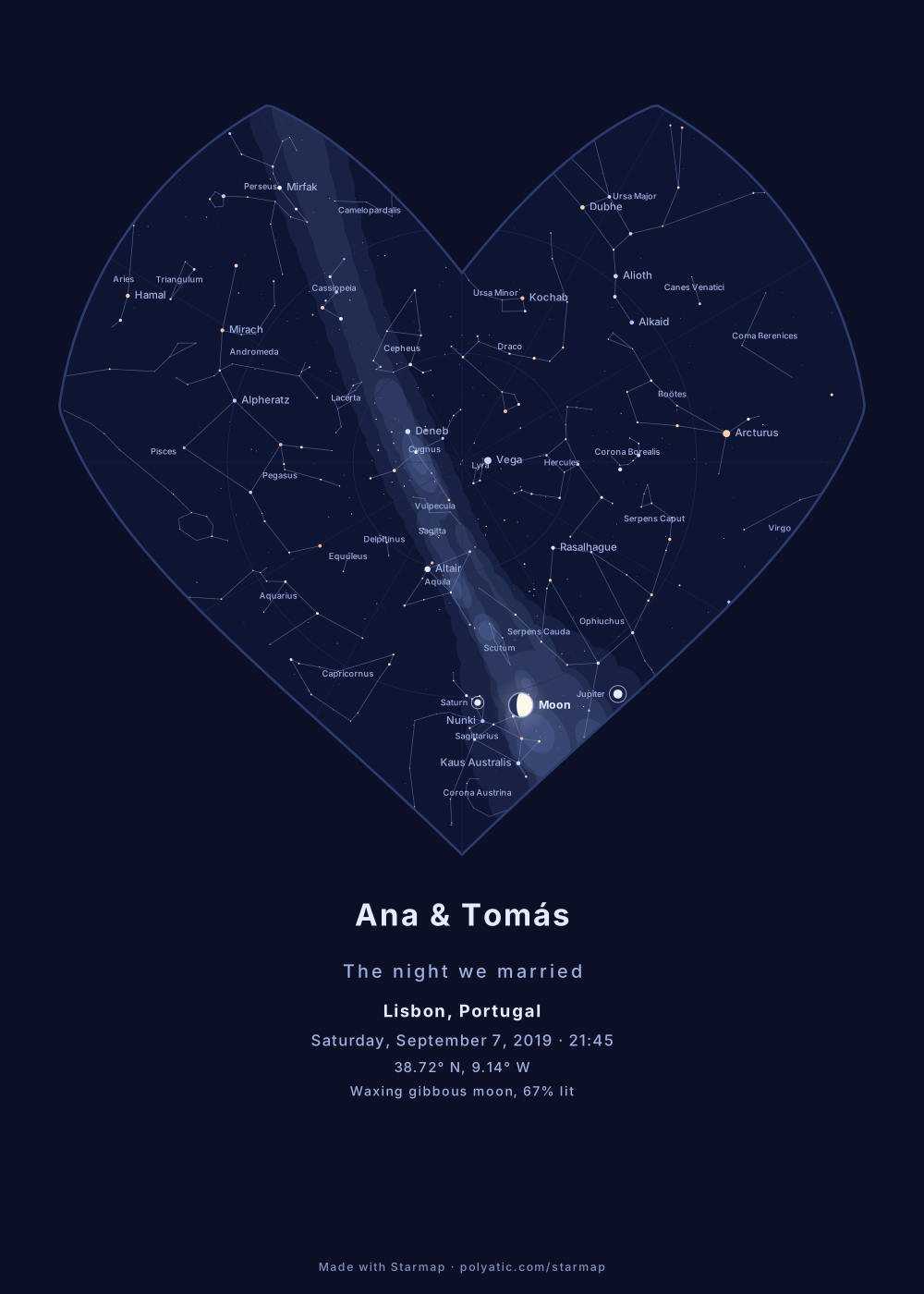
The same computed sky as the round chart, every star where it stood over your town at that minute, but trimmed to a heart: the point aims at the southern horizon, the notch sits in the northern sky, and the lobes reach the rim in the north-east and north-west. Your title, place, date and time sit under it unchanged.
Make a heart star map
Free, no account, nothing to buy. Opens the one-sky poster with Shape set to Heart; set it back to Circle there to see the whole sky again.
What the heart keeps
A round chart is the whole sky above the horizon: the zenith in the middle, the horizon at the rim. The heart is cut from that disc and covers 72.9 % of its area. Everything near the middle survives, which is the high sky, the part you see when you lie on your back. Toward the edge it depends on direction, measured from the centre of the chart:
- South, toward the point: kept down to about 2° above the horizon, so a low Moon or planet in the south usually stays on the poster.
- North-east and north-west, under the two lobes: kept right down to the horizon.
- Due east and due west: kept to about 4° up.
What falls outside it
- Either side of the point (south-east and south-west): everything lower than 12 to 19° is cut.
- Above the notch (due north): everything lower than 40° is cut, and 15° either side of north, everything below 21°. The Pole Star stands as high as your latitude, so from anywhere south of about 40° N it falls into the notch. From Lisbon (38.7°) it is left out; from London or Copenhagen it stays in.
- The compass letters and the horizon ring. The edge is no longer the horizon, so the N, E, S and W letters go and the heart’s outline takes the ring’s place.
Whatever lies beyond the outline is left out of the file itself rather than hidden under a mask, so the downloaded SVG holds only what you see. Constellation lines that cross the outline stop at it, and a name is printed only where it fits wholly inside.
How many stars that is
The low sky holds a large share of the stars in the catalogue (every star down to magnitude 5.0), so the count matters more than the area. Under the generator’s preview a line states it for your own moment, in the form “The heart shows 645 of them and leaves out 137”, and names any planet that was up but falls outside. In ten test renders on 7 September 2019 (Lisbon, London, New York, Sydney and Copenhagen, each at two hours of the night) the heart left out between 114 and 169 stars, roughly one in six. In one of them, London at 22:00 local time, Jupiter was up low in the south-west and fell outside the outline; the line said so.
If the one star you care about is low in the north, check the preview before you print, or move the time: half an hour later the sky has turned 7.5° and a star near the edge may be inside.
What the chart draws
The chart holds the 1,630 stars brighter than magnitude 5.0 and the 89 constellation figures, and the Milky Way is drawn as a soft band. The Moon is drawn in its real phase, and left off when it was below your horizon. The five naked-eye planets, Mercury, Venus, Mars, Jupiter and Saturn, are drawn where they stood. The Sun is drawn too whenever it was up, and the caption says whether your moment was daylight, twilight or full dark: the stars are always drawn where they stood, even when daylight or twilight hid them. So is an eclipse, if your moment falls inside one. Uranus, Neptune and 133 deep-sky objects are one switch away: tick Deep-sky objects and the chart marks the Messier objects and southern showpieces and adds Uranus and Neptune (see them over London on a winter evening). Great comets since 1900 can be added (Hale-Bopp over London, 1997). Not drawn: faint comets and satellites, whose orbits this tool does not compute. Every position is carried to your date by precession. Not modelled: the stars’ own proper motion. A date before 15 October 1582 is read in the Julian calendar. It all runs in your browser, nothing is uploaded, and the downloads are complete and free. Accuracy, print sizes and privacy, answered in full.
Common questions
Which stars does the heart leave out, and how many?
The low sky either side of its point (south-east and south-west, below 12 to 19°) and the sky above its notch (due north, below 40°). The generator counts them for your moment and says so under its preview: for the Lisbon sample it shows 645 of the 782 stars above the horizon and leaves out 137. Across ten test nights the number left out ran from 114 to 169. A planet or the Moon in those areas is left off too, and the line names it.
Is the heart poster square or portrait?
Every print size is portrait, from A4 and US Letter up to 70 × 100 cm, with the heart in the upper part and the words below it. On 50 × 70 cm the heart is about 44 cm wide and 40 cm tall; on A4 about 18 by 17 cm. There is no square paper size. The square option is the 1080 × 1080 “Square post” screen format, where the heart spans about two thirds of the width; it downloads as PNG or SVG, not PDF. For a square frame use its SVG, which stays sharp at any size; the PNG is only 1080 pixels, about 9 cm at 300 dpi.
Can I print a heart star map at home?
Yes. Pick A4 or US Letter and download the PDF: the page measures exactly that size and keeps every mark 6.35 mm inside the edge, the margin most home printers need. The heart comes out about 18 cm wide on A4 and 7.2 in on Letter. The navy theme covers the sheet in dark ink; the ink theme, dark lines on a warm white page, uses far less and suits plain or textured paper.
Does cutting the sky to a heart change the caption?
No. The title, subtitle, place, date, time, coordinates and Moon phase line print exactly as on the round chart, and the stars inside the heart are in exactly the same places. The heart is offered on the one-sky poster only; the two-sky, family and Sky + Moon layouts keep their circles.