The Night Sky on Your Birthday, With Your Star Ringed
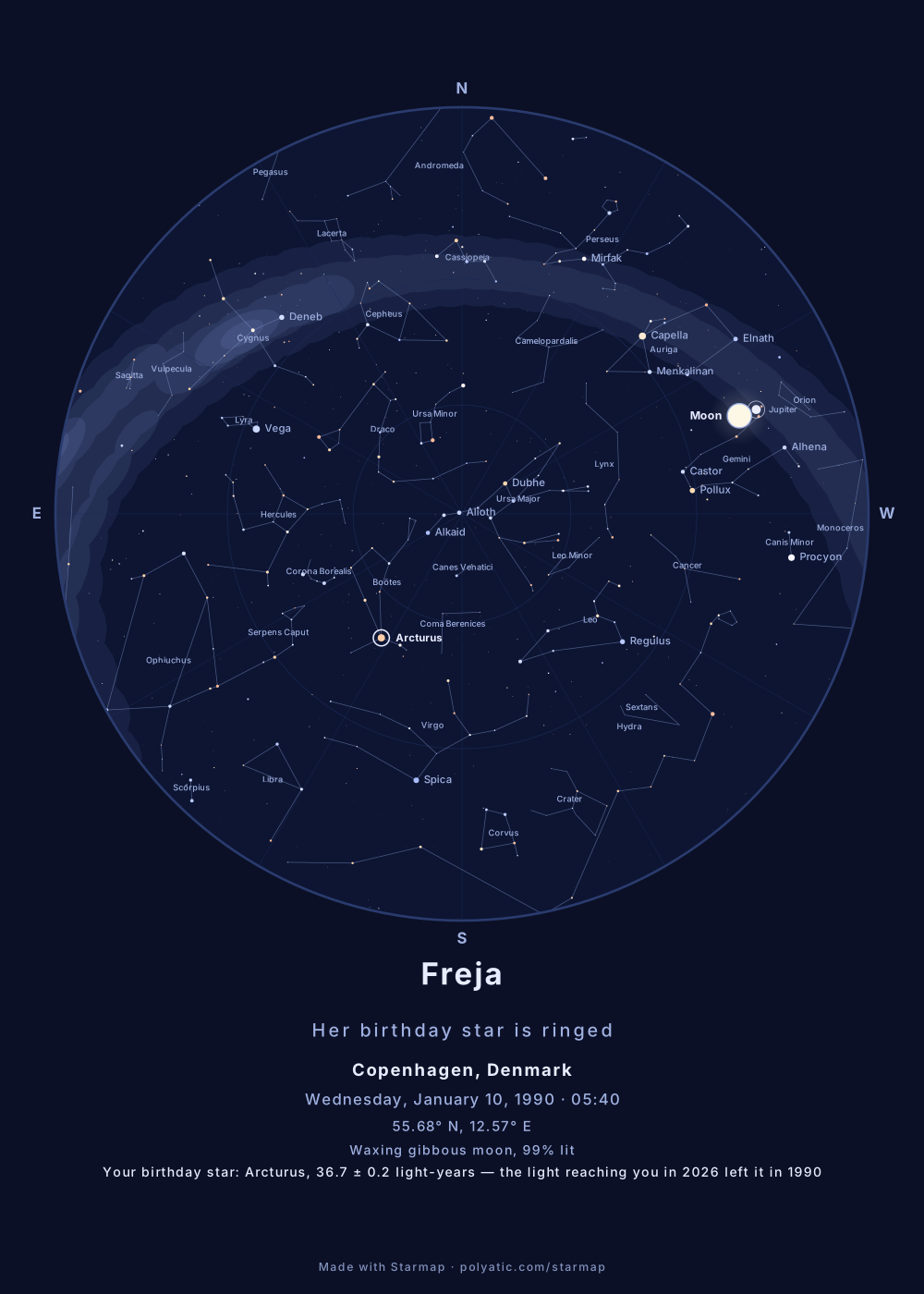
This is the chart of your first night: every naked-eye star over your birthplace at the minute on your birth record. One of them is ringed and named. Its distance in light-years is your age, so the light from it that reaches you this year set out around the day you were born.
Make my birthday star map
Free, no account, nothing to buy. Birthday star is already ticked when the generator opens; type your birth date, time and town there, or use the form at the top.
How the generator picks the star to ring
- It counts the years from the poster’s date (your birth) to the day you tick the box: 36.7 for Freja above.
- It looks through the 1,417 naked-eye stars whose distance is measured to better than 10 % (Hipparcos parallaxes, van Leeuwen 2007) for the smallest gap between distance and age, and keeps every star within half a light-year of that best gap.
- Of those, it prefers one that stood above the horizon over your birthplace at your birth minute, and among those the closest match, then the brightest. That star gets the ring and its name on the chart.
- If none of them was up that night, the poster still names the star and its distance, and adds “below the horizon that night” to the line, because there is nothing above your horizon to ring.
The line under the date carries the number with its measurement error, as the sample’s does. Under the checkbox the generator also says where to look for the star tonight at 22:00 from the poster’s town (direction and height), or the month it stands highest at that hour if it is down tonight.
Why the birth minute and the town matter here
The star is picked by your age alone, but whether it gets a ring depends on your sky. Arcturus, Freja’s star, is a spring-evening star in the north: at 05:40 on a January morning over Copenhagen it was already half-way up in the south-south-east, so it is ringed. At 21:00 on the same date it was below the horizon, and her poster would have named it without a ring. From Sydney it never climbs higher than 37°, in the north, and from south of about 71° S it never rises at all.
The match is not always exact. No star lies within half a light-year of ages 5–8, 13–15, 18, 21, 23, 31–33, 62 and 68, and under four nothing is close enough (α Centauri, the nearest, is 4.1–4.3 light-years away). The poster then names the nearest star and the year its light really left, rather than pretending. A poster made next year keeps the star it was made with: the day you ticked the box travels in the permalink. For every fifth birthday from 10 to 80 with its star and uncertainty, see Find your birthday star.
Or print it as a card tonight
A poster still needs a frame before it is a present. Tick Make it a folded card instead in the form (or pick Layout → Card in the generator) and the same sky is laid out four to one side of a single A4 or US Letter sheet, which folds twice into a greeting card: an A6 card (10.5 × 14.8 cm) from A4, a 4.25 × 5.5 in card from Letter.
- Front: the sky disc and your title, in the poster’s colours.
- Inside: your dedication, centred, up to six lines of 60 characters (the poster takes three), typed under More text. The facing page is left blank for a handwritten note.
- Back: the place, the date and time, the coordinates and a one-line credit.
The top half of the sheet prints upside down on purpose: the first fold turns it over top-to-bottom and the second left-to-right, and two half-turns make it read upright on the finished card. Print at 100 % (not “fit to page”), fold the top half back behind the bottom half with the print outside, then fold left over right. Every panel keeps 8 mm clear of the folds and the sheet edge, so the strip a home printer cannot reach (about 3–6 mm) cuts nothing off, and short grey ticks at the edges show where to fold. Plain printer paper makes a thin, floppy card; heavier paper folds crisper, but many printers only take it through a rear or manual feed. Download PDF writes the sheet at its true size (21 × 29.7 cm for A4, 8.5 × 11 in for Letter); PNG and SVG are the same sheet.
What the chart draws
The chart holds the 1,630 stars brighter than magnitude 5.0 and the 89 constellation figures, and the Milky Way is drawn as a soft band. The Moon is drawn in its real phase, and left off when it was below your horizon. The five naked-eye planets, Mercury, Venus, Mars, Jupiter and Saturn, are drawn where they stood. The Sun is drawn too whenever it was up, and the caption says whether your moment was daylight, twilight or full dark: the stars are always drawn where they stood, even when daylight or twilight hid them. So is an eclipse, if your moment falls inside one. Uranus, Neptune and 133 deep-sky objects are one switch away: tick Deep-sky objects and the chart marks the Messier objects and southern showpieces and adds Uranus and Neptune (see them over London on a winter evening). Great comets since 1900 can be added (Hale-Bopp over London, 1997). Not drawn: faint comets and satellites, whose orbits this tool does not compute. Every position is carried to your date by precession. Not modelled: the stars’ own proper motion. A date before 15 October 1582 is read in the Julian calendar. It all runs in your browser, nothing is uploaded, and the downloads are complete and free. Accuracy, print sizes and privacy, answered in full.
Common questions
I don't know my birth time. Will the ring be wrong?
The star itself does not depend on the time, only on your birth date. The time decides whether it was above the horizon, and so whether it is ringed: the sky turns 15° an hour, so a star near the horizon can be up at 23:00 and down at 01:00. Slide through the night with the slider under the chart and watch whether the ring stays.
Will my zodiac constellation be on the chart?
Usually not. A sun sign is, by definition, the constellation behind the Sun on your birthday, so it is up by day and down at night. It is best seen about six months later.
Can a twin, a parent and a child have different birthday stars?
Twins share one: same date, same age, same star, ringed the same way if born minutes apart. A parent and child have stars as far apart as their ages, because each star is picked by its own distance.