The Night Sky on Your Birthday: Planets and Moon
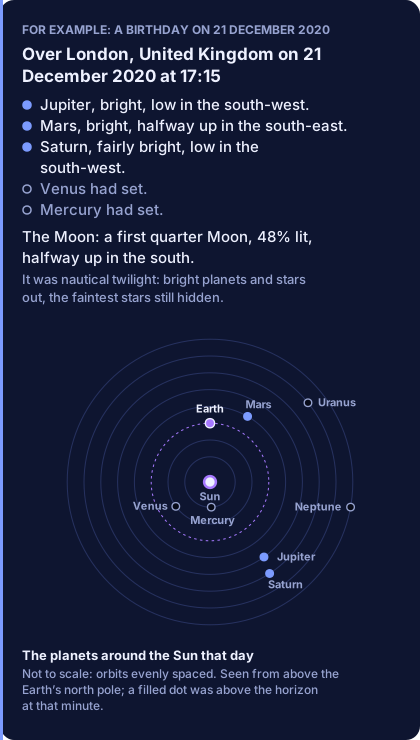
Planets first. Type the day you were born and the town, and this page says which of Mercury, Venus, Mars, Jupiter and Saturn were above the horizon that night and in which direction, gives the Moon’s phase and place, and draws all eight planets around the Sun as they stood that day.
Make the star map of that night
The star map opens with your date, time and town filled in, the planets and the Moon already drawn where they stood. Free, no account.
What the answer tells you
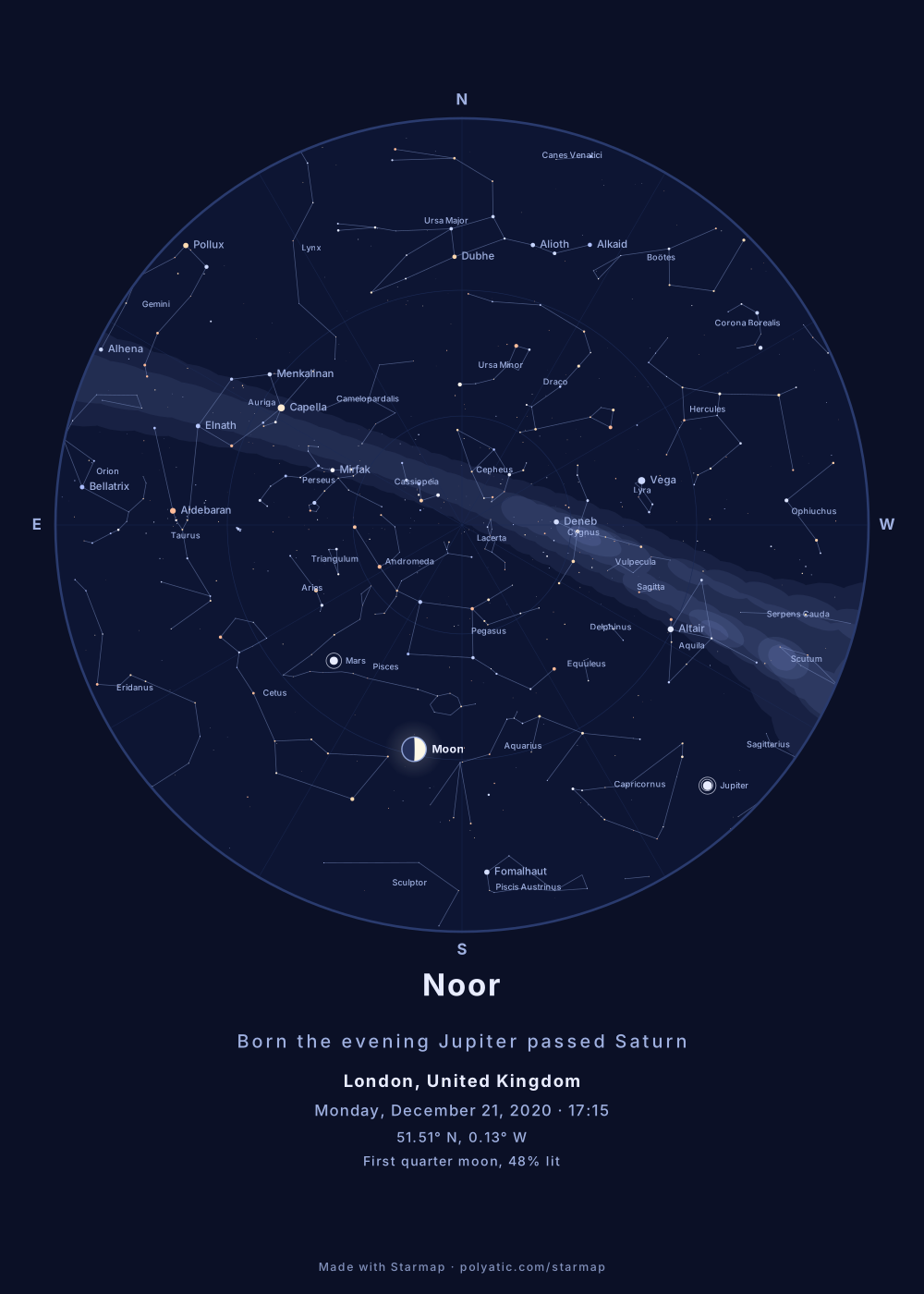
Three things, in that order. First, a sentence per naked-eye planet: direction in compass words (south-west, low, halfway up) and brightness in plain words, worked out for your town at that minute, or the plain fact that it had set or not yet risen. A planet counts as up here on exactly the rule the star map uses for its own read-out under the chart, so the two never disagree. Second, the solar system seen from far above the Earth’s north pole: the Sun in the middle, the eight planets on their orbits, each placed at its real heliocentric longitude, the angle around the Sun measured from the direction of the March equinox. Third, the star map of that night, with the planets drawn among the constellations.
The sentences change with the hour and the town; the top-down picture does not. The Earth turns 15° an hour, so a planet low in the west at 21:00 can be gone by 22:00, but where the planets sit around the Sun moves slowly: Mercury, the fastest, about 4° a day, Neptune about 2° a year.
“How were the planets aligned?” What that can honestly mean
All eight planets orbit close to one flat plane. Mercury’s orbit is tilted 7° to the Earth’s, every other one by less than 3.4°. Seen from inside that plane, they always lie along one band across our sky, the ecliptic, the same path the Sun and the Moon follow. That is the whole of any alignment: a line of sight, an arrangement in space, and nothing more is read into it here.
The example at the top shows how different the two views can be. On 21 December 2020 Jupiter and Saturn stood 7 arcminutes apart in London’s evening sky, a quarter of the Moon’s width, the tightest pairing since 1623. From the Sun they were 2.6° apart, and Saturn was twice as far out: 10.0 au from the Sun against Jupiter’s 5.1, or about 730 million km apart in space. They lined up only as seen from the Earth.
Your birthday, year after year
The Earth comes back to the same place every birthday: on 18 June it is at about 267° in the diagram, in 1994 and in 2026 alike, because a year is one orbit. Everything else has moved on. Jupiter takes 11.9 years to go round, so on each birthday it is about 30° further along, and back near the same spot around your 12th, 24th and 36th birthdays. Saturn needs 29.5 years, Uranus 84 and Neptune 165, so Neptune has moved only 70° between a 1994 birthday and the same date in 2026. Venus nearly repeats every 8 years, because 13 of its orbits take 8 years less about a day: on 18 June 1994 and 18 June 2026 it was at 182° and 188°.
What it leaves out
The sentences cover the five planets you can see without help. Uranus, around magnitude 5.7, is at the limit of a dark sky, and Neptune needs binoculars, so they appear only in the top-down picture (and on the star map when you tick Deep-sky objects). The horizon is taken as flat, so hills, trees or houses can hide a planet the answer calls low. A planet that was up in daylight was still there, but the Sun hid it, and the answer says when the sky was not yet dark. Positions come from JPL’s published orbital elements, valid from 3000 BC to 3000 AD: for the two nights tested, each heliocentric longitude is within 0.1° of NASA/JPL Horizons. Without a birth time the answer uses 21:00 and says so; the Moon’s phase barely changes in a few hours, the planets in your sky can.
What the chart draws
The chart holds the 1,630 stars brighter than magnitude 5.0 and the 89 constellation figures, and the Milky Way is drawn as a soft band. The Moon is drawn in its real phase, and left off when it was below your horizon. The five naked-eye planets, Mercury, Venus, Mars, Jupiter and Saturn, are drawn where they stood. The Sun is drawn too whenever it was up, and the caption says whether your moment was daylight, twilight or full dark: the stars are always drawn where they stood, even when daylight or twilight hid them. So is an eclipse, if your moment falls inside one. Uranus, Neptune and 133 deep-sky objects are one switch away: tick Deep-sky objects and the chart marks the Messier objects and southern showpieces and adds Uranus and Neptune (see them over London on a winter evening). Great comets since 1900 can be added (Hale-Bopp over London, 1997). Not drawn: faint comets and satellites, whose orbits this tool does not compute. Every position is carried to your date by precession. Not modelled: the stars’ own proper motion. A date before 15 October 1582 is read in the Julian calendar. It all runs in your browser, nothing is uploaded, and the downloads are complete and free. Accuracy, print sizes and privacy, answered in full.
Common questions
Which planets could I have seen on the night I was born?
Those this page lists as up, provided the sky was dark enough and the horizon clear in that direction. Venus and Jupiter, the two brightest, show even in twilight; Mercury never strays more than 28° from the Sun, so it is only ever low, at dusk or dawn. A planet within a degree of the horizon is called just rising or just setting, because in practice almost any skyline hides it.
Why is the Earth in the top-down picture at a different place from the Sun in my sky?
They are opposite each other. Seen from the Sun, the Earth on your birthday sits at some longitude; seen from the Earth, the Sun sits at that longitude plus 180°. On 18 June the Earth is near 267°, and the Sun appears in our sky in the direction of 87°.
Does the time of birth matter?
For the sentences, yes: the Earth turns a quarter of the sky every six hours, so the planets up at 06:00 and at 18:00 are often different ones. For the top-down picture, hardly: in a day Mercury moves about 4°, the Earth 1°, the outer planets almost nothing. Without a time the page uses 21:00 that evening and says so.
How accurate are the planet positions?
They come from E. M. Standish's Keplerian elements published by JPL (Uranus and Neptune from a shortened VSOP87 series). For 1800 to 2050 JPL states a worst error of 15 arcseconds for Mercury up to 10 arcminutes for Saturn; this page's test compares 16 heliocentric longitudes on 18 June 1994 and 21 December 2020 with NASA/JPL Horizons and finds them all within 0.1°. Dates before 1582 are read in the Julian calendar.