The Moon the Night You Were Born
Pick Moon under Layout and the generator draws the Moon as it hung over one town at one minute: lit to that night's phase, turned the way it stood in that sky, and placed in words, how high and in which direction. The face is NASA's own map of the Moon, not a drawing.
Draw the Moon for your date
Free, in your browser, with no account and nothing to buy. The SVG, the 300 dpi PNG and the PDF (a real page of the size you pick, from 21 × 29.7 cm to 70 × 100 cm) are each the complete poster.
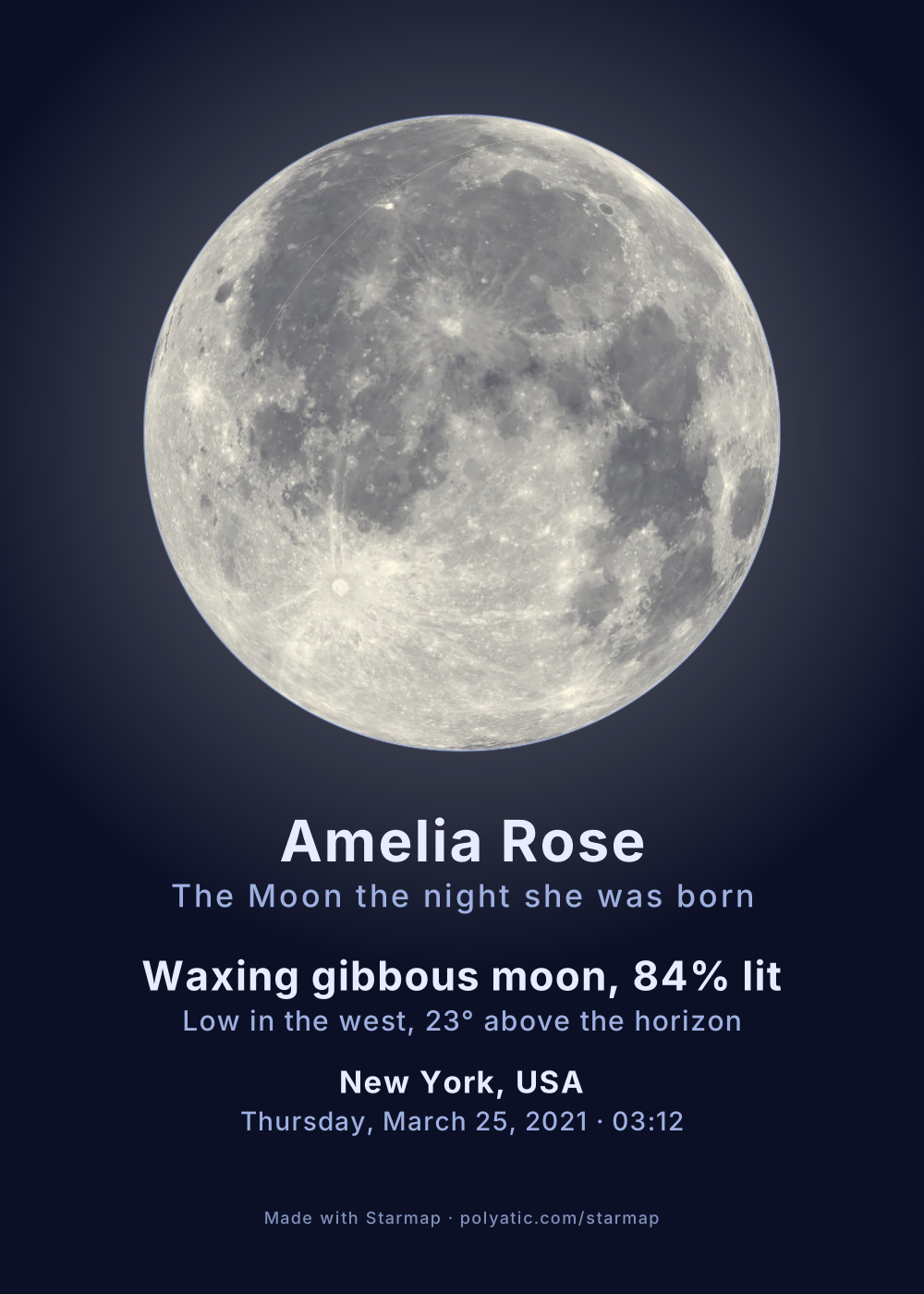
Most answers to “what did the Moon look like the day I was born” are a phase name and a generic icon: waxing gibbous, a white disc with a bite out of the left. That is half the answer. The phase is the same for everyone on Earth at a given moment, but how the Moon looked also depends on where you were: whether it was up at all, how high it stood, and which way its lit side pointed. A Moon poster from this generator settles all of it for one date, one time and one town, and prints it.
What the poster shows
- The phase, in words and in light: the line under the Moon names it (“Waxing gibbous moon, 84% lit”) and the lit part of the disc is drawn to that fraction. Near first and last quarter the number moves fast — over Paris at 21:00 it was 42 % on 3 May 2025, 52 % on the 4th and 62 % on the 5th — so the date matters more than people expect.
- Where it stood: a second line gives its height and compass direction, as in “Low in the west, 23° above the horizon”.
- The real face: the craters and dark maria come from the Lunar Reconnaissance Orbiter colour mosaic in NASA’s CGI Moon Kit, turned so lunar north points where it did in that sky and centred on the side the Moon showed that night (its slow nodding, called libration, lets us see up to about 8° further round one edge or another). The dark part is drawn faintly, as earthshine.
- Your words: a title, a subtitle, the town and the date and time, exactly as on the star map.
Phase and tilt: why the same Moon looks turned
The phase is how much of the Moon’s sunlit half faces Earth. It depends only on the moment, so a Moon that is half lit in Paris is half lit in Sydney. The tilt is which way that lit side points from where you stand, and it depends on your latitude and on the hour, because you see the Moon from a different angle and it swings across the sky through the night. Two posters for the same evening, 4 May 2025 at 21:00 local time, show the difference:
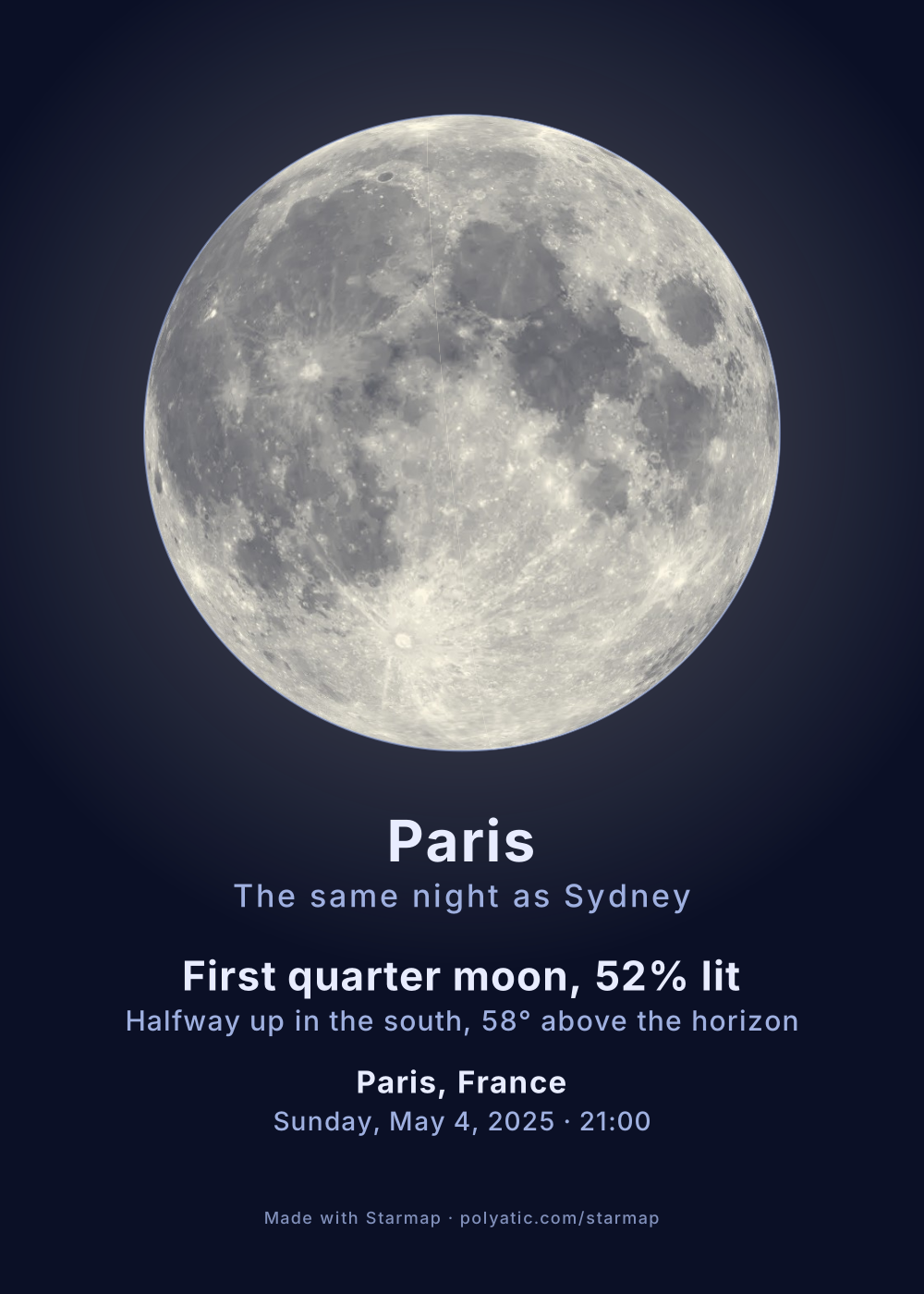
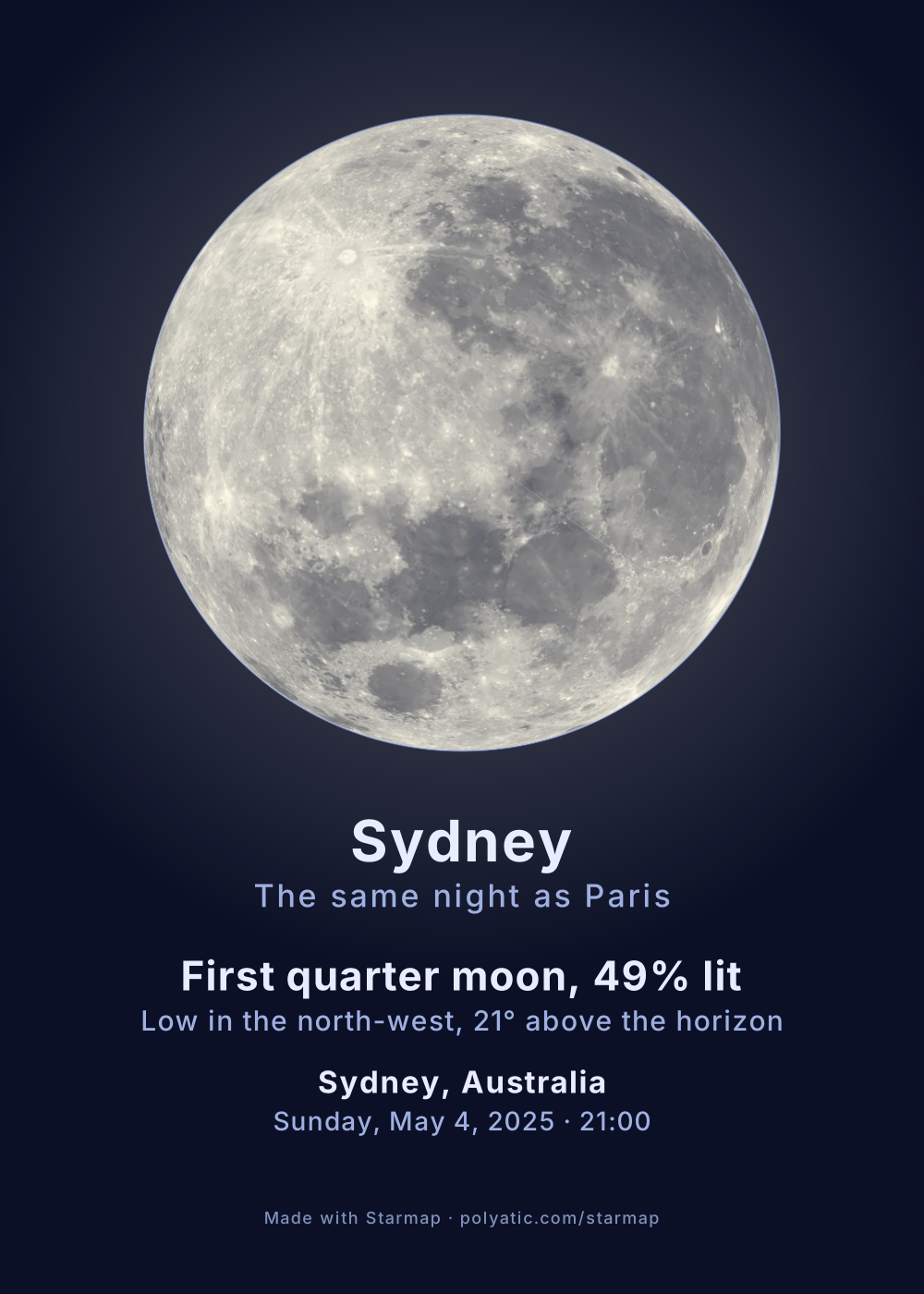
In Paris the Moon stood 58° up in the south, and its lit half faced right, towards the west where the Sun had set. In Sydney, where 21:00 came eight hours sooner, it was 21° up in the north-west. Facing north to see it, west is on your left, so the lit half faced down and to the left, and the face itself is turned round by about 130° compared with Paris: the “upside-down Moon” people notice when they travel south. The phase on the two posters differs by three points, 52 % and 49 %, only because eight hours passed. The hour changes the tilt in one town too: over Paris that evening the bright side pointed up and to the right at 18:00, straight right at 21:00 and down and to the right by 23:00.
Open the Paris poster · Open the Sydney poster
When the Moon was below the horizon
About half of all birth times fall while the Moon is down. The poster does not pretend otherwise and does not leave the page empty: it draws the Moon as it looked when it next rose over that town, and says so in its second line, in these words: “Below the horizon at 02:00 · drawn as it rose at 10:05, in the north-east”. That example is Paris at 02:00 on 17 June 2018, when a 17 %-lit crescent was down all night and rose the next morning. If the next rise is on another day, the rise time carries its date. Close to the poles, where the Moon can stay down for days, the line reads “Below the horizon at … · it does not rise in the next 30 days” when that is true. When the Moon is drawn at its rise, the phase line above is the phase at that rise too, so the words and the picture always describe the same Moon; in the Paris example it had grown from about 14 % at 02:00 to 17 % by 10:05.
Printing it
The Moon poster comes in the same sizes and downloads as the star map. On A4 the Moon is about 14 cm across, and the PDF is a real 21 × 29.7 cm page for a home printer. At 50 × 70 cm, a frame size sold off the shelf across Europe, it is about 34 cm across; send the PDF to a print shop, or use Print at home on A4 / Letter sheets to get the same poster on 9 A4 sheets that overlap by 10 mm and tape together. 30 × 40 cm, 18 × 24 in and the other standard frame sizes are in the same menu. An honest limit: the face is a 768-pixel image, which prints at about 135 pixels per inch on A4 and looks sharp at arm’s length, but at 50 × 70 it is about 57 per inch, fine from across a room and soft from close up. The outline, the phase edge and all the lettering are vector and stay sharp at any size.
If you want the stars as well, pick Sky + Moon under Layout: the round star chart of that moment and the Moon as it hung, on one poster under one title, with the place, the date and the phase line beneath both.
Two, three or four Moons on one print
Pick Moons of your days (2–4) under Layout and the Moon is drawn for up to four moments at once, together on one sheet: the night you met, the evening you got engaged and the wedding day, or the Moon on each child’s birthday. Each Moon has its own date, time and town and is worked out exactly as the single Moon poster works it out, so its phase, its tilt and its below-the-horizon line are the ones that town saw at that minute. Beside each Moon go your label (up to 30 characters, such as “We met”), the date, the town and the phase; the title sits on top and a dedication of up to three lines under all of them.
An example: London at 22:30 on 10 September 2016, Paris at 20:00 on 14 February 2019 and London at 16:00 on 3 July 2021. The first two are both waxing gibbous, 64 % and 70 % lit, which a phase icon would draw almost alike; here the London Moon stood 12° up in the south-west with its lit side turned down and to the right, and the Paris Moon 60° up in the south, lit straight from the right. The third, a waning crescent 30 % lit, was below the horizon that afternoon, so it is drawn as it rose at 01:41 the next night, and its caption says so.
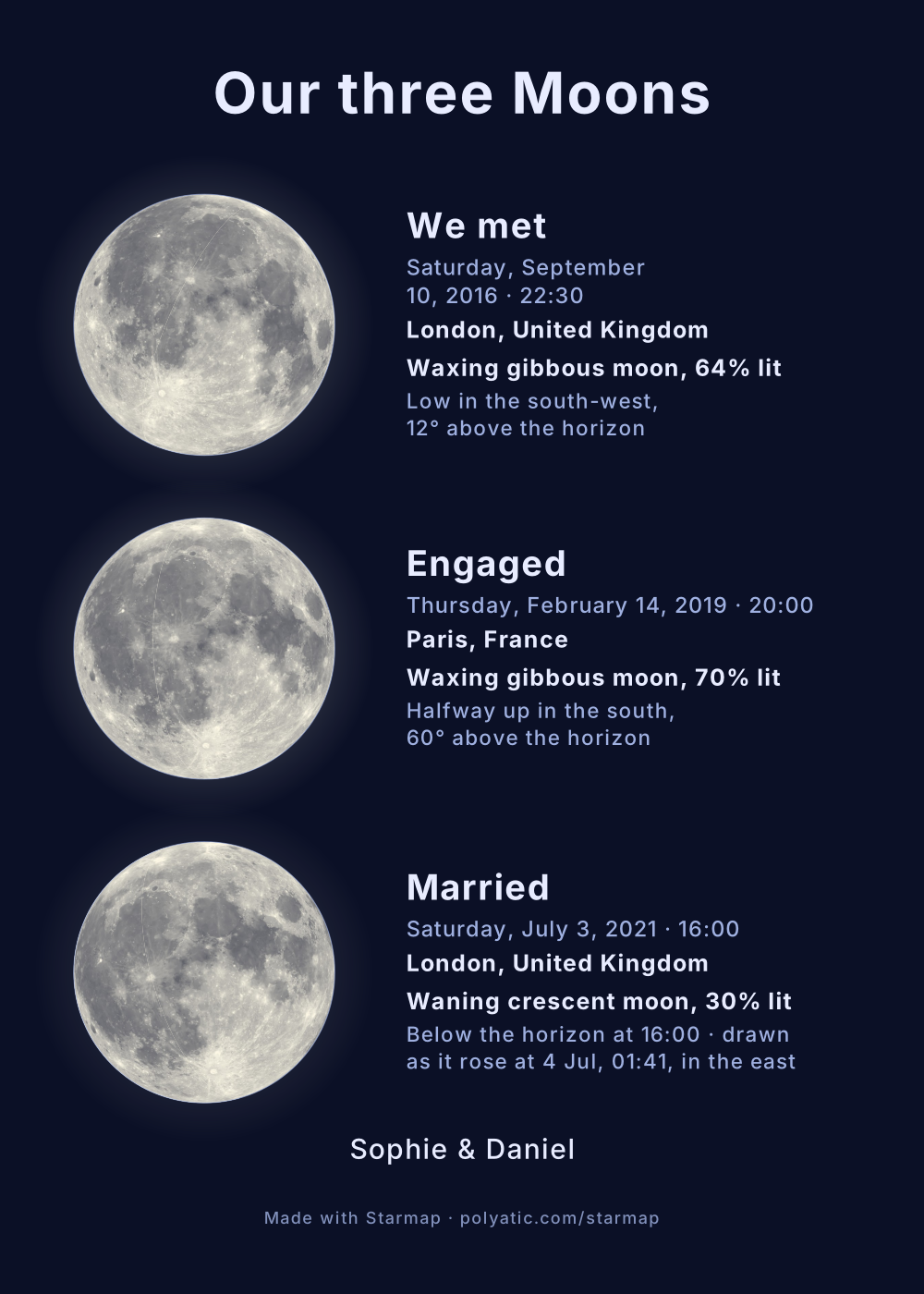
On a portrait or square print two or three Moons stack down the sheet with their words beside them (on a landscape screen they sit in one row), and four make a 2 × 2 grid. On A4 two Moons are about 7.5 cm across, three about 6 cm and four about 5.5 cm; on 50 × 70 cm three are about 14 cm across. It comes in the same paper sizes, themes and downloads (PNG, PDF, SVG) as the Moon poster, and has a page of its own with a form for up to four days. Open this three-Moon print and change the dates, times, towns and labels to yours.
Just the numbers
If you only need the figures — the exact percentage, the Moon’s age in days, moonrise and moonset for that day, and the next full moon — the Moon phase calculator gives them for any date and town, without a poster.
What the chart draws
The chart holds the 1,630 stars brighter than magnitude 5.0 and the 89 constellation figures, and the Milky Way is drawn as a soft band. The Moon is drawn in its real phase, and left off when it was below your horizon. The five naked-eye planets, Mercury, Venus, Mars, Jupiter and Saturn, are drawn where they stood. The Sun is drawn too whenever it was up, and the caption says whether your moment was daylight, twilight or full dark: the stars are always drawn where they stood, even when daylight or twilight hid them. So is an eclipse, if your moment falls inside one. Uranus, Neptune and 133 deep-sky objects are one switch away: tick Deep-sky objects and the chart marks the Messier objects and southern showpieces and adds Uranus and Neptune (see them over London on a winter evening). Great comets since 1900 can be added (Hale-Bopp over London, 1997). Not drawn: faint comets and satellites, whose orbits this tool does not compute. Every position is carried to your date by precession. Not modelled: the stars’ own proper motion. A date before 15 October 1582 is read in the Julian calendar. It all runs in your browser, nothing is uploaded, and the downloads are complete and free. Accuracy, print sizes and privacy, answered in full.
Common questions
Did everyone on Earth see the same Moon the night I was born?
The same phase, yes: at any moment the Moon is the same percentage lit everywhere. Whether it was up, how high, and which way its lit side pointed depend on the town and the hour. On 4 May 2025 at 21:00 the half-lit Moon was 58° up in the south over Paris, lit on the right, and 21° up in the north-west over Sydney, lit on the lower left.
I don't know the time I was born. Is the poster still right?
The phase nearly is. It changes by at most about 13 percentage points a day, fastest near first and last quarter and slowest near full and new moon, so any time on the right date gives a phase within about 6 points of the true one. Whether the Moon was up, its height and its tilt do depend on the time. The generator starts at 21:00; if you know only "morning" or "night", pick a time in that part of the day.
Is the Moon's face a photo from that night?
No. It is NASA's map of the whole Moon, made from Lunar Reconnaissance Orbiter images (the CGI Moon Kit from NASA's Scientific Visualization Studio), shaded to the computed phase, turned to the computed tilt and centred on the side the Moon was showing that night. It is the right Moon in the right position, not a photograph of the sky over your town.
What if it was cloudy?
The poster cannot know the weather. It shows where the Moon was and how it was lit, which is what you would have seen through a clear sky.
How accurate is it?
The positions use the same lunar theory as the star map (truncated ELP-2000/82, about 0.003°). The test suite checks the drawn poster against NASA JPL Horizons for Paris and Sydney: the percentage lit to within 1 point, and the direction of the lit side and of lunar north to within 3°. Refraction near the horizon is not modelled, so in the last half degree above the horizon "up" or "down" can be a few minutes early or late.
Does it cost anything?
No. The poster, the SVG, the 300 dpi PNG, the print-size PDF and the tiled A4 version are all free, with no account. Nothing is uploaded: the Moon is computed in your browser.