A Family Star Map: Every Child's Birth Night on One Poster
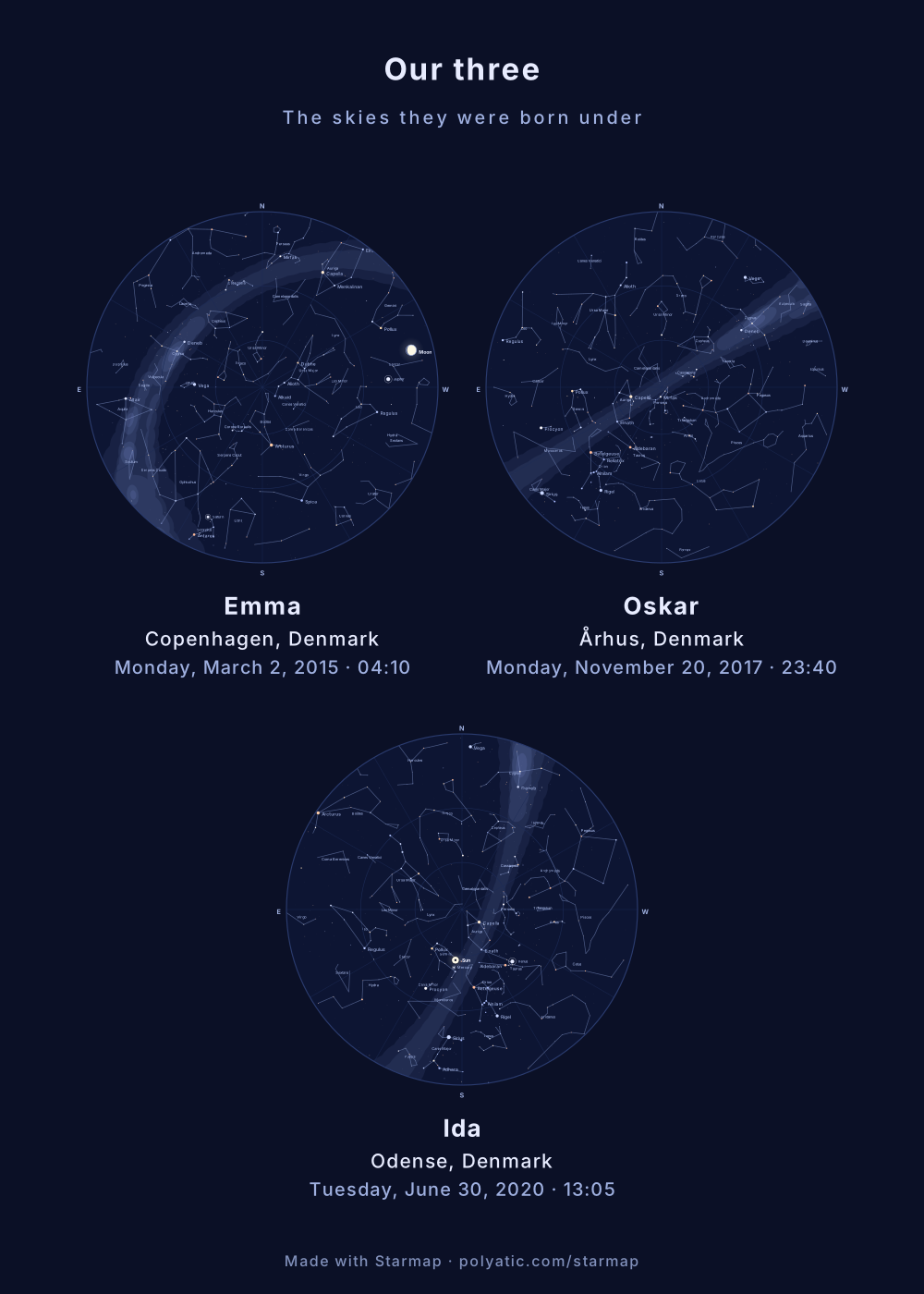
One round chart for each child, side by side on one sheet: the sky over the town where each was born, turned to the minute on the birth record, with the child’s name above the place and date. Three skies sit two over one on a portrait print; a fourth makes a two-by-two grid.
Start a family poster
Free, no account, nothing to buy. Opens the Family layout with three skies; give each its date, time, town and name there, or use the form at the top.
What each disc on the family poster holds
Every sky is a complete chart of its own, not a copy of the first one with a new caption: its own date and clock time, its own town and that town’s time zone and summer time on that date, its own Moon and planets. Above each place line goes a name of up to 30 characters. Across the top go one title and one subtitle for the whole sheet, and under all the skies a dedication of up to three lines, written once in the generator.
Three siblings, three different skies
The sample above is three made-up children, worked out the way yours will be:
- Emma, Copenhagen, 2 March 2015 at 04:10. Fully dark; an 89 % waxing gibbous Moon hangs low in the west with Jupiter nearby, Saturn is low in the south-east and Arcturus is the brightest star up.
- Oskar, Århus, 20 November 2017 at 23:40. The thin 6 % crescent had already set and no naked-eye planet was up; Sirius sits low in the south-east.
- Ida, Odense, 30 June 2020 at 13:05, summer time. A lunchtime birth: the Sun is drawn 58° up in the south, with Venus and Mercury, and the stars are drawn where they stood behind the daylight.
The discs differ for two reasons. The clock time: the sky turns 15° an hour, so a 04:10 arrival and a 23:40 one face different stars even on the same date. And the season: at the same clock time the sky is about 2 hours (30°) further round each month, because Earth has moved along its orbit; a March night and a November night show largely different constellations overhead. Towns 140 km apart, like Copenhagen and Odense, turn the sky by about 2°, so siblings born in the same country differ by date and hour far more than by place.
How large each sky prints
On a portrait sheet each disc is about 38 % of the sheet’s width: 19 cm across on 50 × 70 cm, 11 cm on A3 and 30 × 40 cm, 7.8 cm on A4 or US Letter. The star and constellation names shrink with the disc, so an A4 family poster is for reading close up; for a wall, pick 50 × 70 cm or larger. Four skies use the same disc size as three.
What the family layout leaves out
Four skies is the most it draws; a fifth child needs a second poster (a two-sky one sits well beside it). Like the two-sky poster, it leaves off the Birthday star ring, the deep-sky symbols and the meteor radiant, which belong to the one-sky chart. Twins born minutes apart get near-identical discs, so a one-sky chart with both names in the title says the same at a larger size.
What the chart draws
The chart holds the 1,630 stars brighter than magnitude 5.0 and the 89 constellation figures, and the Milky Way is drawn as a soft band. The Moon is drawn in its real phase, and left off when it was below your horizon. The five naked-eye planets, Mercury, Venus, Mars, Jupiter and Saturn, are drawn where they stood. The Sun is drawn too whenever it was up, and the caption says whether your moment was daylight, twilight or full dark: the stars are always drawn where they stood, even when daylight or twilight hid them. So is an eclipse, if your moment falls inside one. Uranus, Neptune and 133 deep-sky objects are one switch away: tick Deep-sky objects and the chart marks the Messier objects and southern showpieces and adds Uranus and Neptune (see this page’s example with them). Great comets since 1900 can be added (Hale-Bopp over London, 1997). Not drawn: faint comets and satellites, whose orbits this tool does not compute. Every position is carried to your date by precession. Not modelled: the stars’ own proper motion. A date before 15 October 1582 is read in the Julian calendar. It all runs in your browser, nothing is uploaded, and the downloads are complete and free. Accuracy, print sizes and privacy, answered in full.
Common questions
One of our children was born in the daytime. What does that sky show?
The stars that stood above the town at that minute, drawn where they were even though daylight hid them, with the Sun drawn in its real place. In the sample, Ida’s 13:05 birth in Odense puts the Sun 58° up in the south. The generator’s paragraph under the chart says “it was daylight” for that sky, and so does the description inside the SVG download, so nobody mistakes it for a night view.
Can every sky have a different town?
Yes. Each sky has its own town box, and its time is read on that town’s clock, so a child born in Aalborg and one born in Toronto each get their own local time and summer-time rules. Leave a town box empty and that sky uses the first sky’s town. A town typed into the second, third or fourth box is looked up when the generator opens, and the place line under that sky shows the town it found, so check it before you download.
Can I print it at home, or should it go to a print shop?
Both work. The PDF is a real page of the size you pick: A4 or US Letter print on a home printer with a margin the printer can reach, and each disc comes out 7.8 cm wide. For a frame, download 50 × 70 cm (or A3, 18 × 24 in) and send the PDF or the 300 dpi PNG to any print shop.
Why don't the skies look alike if the children share a birthday month?
Because the hour matters as much as the date: the sky turns a quarter of the way round in six hours. Two March births, one at dawn and one just before midnight, have different constellations in the south and different ones rising and setting; only the stars round the pole stay in the same places. The year on its own barely matters for the stars; the Moon and the planets are what change from year to year.