Memorial Star Map: Two Skies for One Life
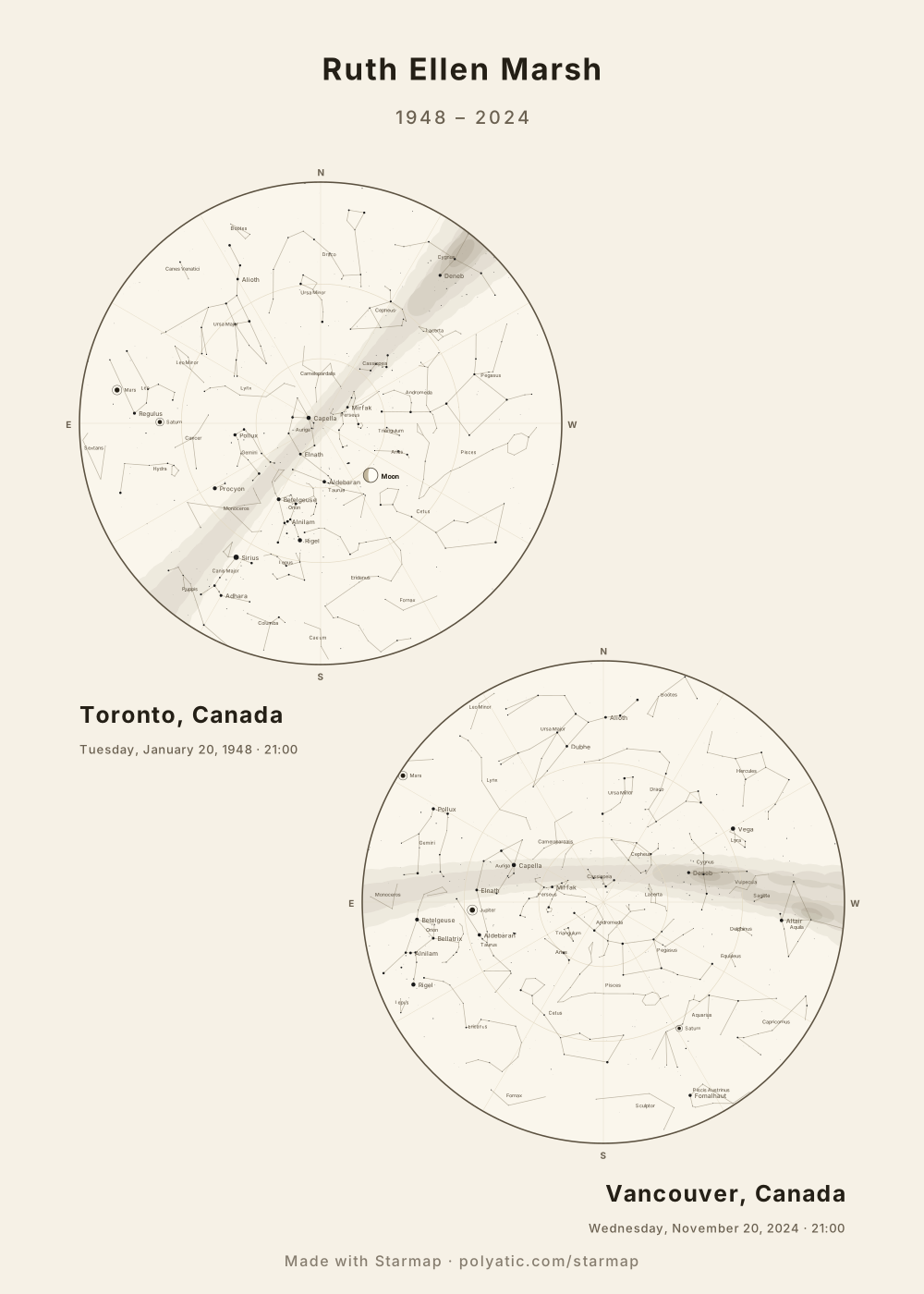
A life has two skies that belong only to it: the one over the town where it began, on the night it began, and the one over the town where it ended. This poster sets them side by side, the same size, under one name. Nothing on it is decoration: both charts are the real stars of those two evenings, and the only words are the ones you type.
Make a two-sky memorial poster
Free, no account, nothing to buy. Opens Two skies on A different night in the ink theme; enter the first date and town, then the second.
Making it
- The first sky. Type the town where they were born, the date, and a time if you know it (21:00 is a gentle default for an evening sky).
- The second sky. Under Layout the poster is already on Two skies with A different night; give the second sky its own town, date and time. Each disc prints its own place and date line, in that town’s own clock.
- The words. The name goes in the title. The subtitle takes one quiet line: the years (“1948 – 2024”), the two towns, or a few words that were theirs. A longer message goes in the dedication, below. The tool adds nothing of its own: no verse, no symbol, no religious image.
- The look. Ink on paper (dark marks on warm white) is the usual choice for a memorial and the cheapest to print; sepia and noir are quieter still.
A dedication under both skies
Under More text, the dedication box takes up to three lines of 60 characters, with your line breaks kept. On the two-sky poster the lines are set centred under both skies, below both skies’ place and date lines, in the same lettering as the title, for example:
For Ruth, who taught us the names of the stars.
She is in every one of them.
1948 – 2024
Top to bottom, the poster then holds the shared title and subtitle, the two discs with each town’s own place and date line, the dedication, and a small credit line. To make room, both discs are taken in by the same amount: three lines cost an A4 or 50 × 70 cm poster about 5 % of each disc’s width, a 4 × 6 in print about 15 %, and the discs never go below 60 % of their usual size. A line too long for the page is set a little smaller rather than cut. If one date carries the memory, the one-sky poster sets the same dedication under its single caption.
What the two dates show
In the sample, the Toronto sky of January 1948 has Capella near the zenith, Orion in the south-east and a 67 % Moon beside Aldebaran; the Vancouver sky of November 2024 has the Summer Triangle setting in the west and Jupiter rising in the east. Seventy-six years apart, the stars themselves barely moved: the constellations are the same shapes, carried about a degree by precession. What changes between the two discs is the season, the hour, the latitude, and where the Moon and planets happened to be, which is exactly what makes each one belong to its own night.
What the chart draws
The chart holds the 1,630 stars brighter than magnitude 5.0 and the 89 constellation figures, and the Milky Way is drawn as a soft band. The Moon is drawn in its real phase, and left off when it was below your horizon. The five naked-eye planets, Mercury, Venus, Mars, Jupiter and Saturn, are drawn where they stood. The Sun is drawn too whenever it was up, and the caption says whether your moment was daylight, twilight or full dark: the stars are always drawn where they stood, even when daylight or twilight hid them. So is an eclipse, if your moment falls inside one. Uranus, Neptune and 133 deep-sky objects are one switch away: tick Deep-sky objects and the chart marks the Messier objects and southern showpieces and adds Uranus and Neptune (see them over London on a winter evening). Great comets since 1900 can be added (Hale-Bopp over London, 1997). Not drawn: faint comets and satellites, whose orbits this tool does not compute. Every position is carried to your date by precession. Not modelled: the stars’ own proper motion. A date before 15 October 1582 is read in the Julian calendar. It all runs in your browser, nothing is uploaded, and the downloads are complete and free. Accuracy, print sizes and privacy, answered in full.
Common questions
Which two dates should the skies show?
Birth and death is the usual pair, but not the only one. Many families find a happy date easier to live with on a wall: the night they were born above, and their wedding night or the day they moved to the coast below. There is no rule, and the generator is free, so you can make more than one and choose later.
We know the birth date but not the time. Is that a problem?
No. The time only turns the chart: an hour is 15° of rotation, and a few stars near the edge come and go. 21:00 gives a full evening sky on most dates of the year. If the caption matters to you, the date line is printed exactly as you enter it, so nothing claims a minute you do not know.
Can I put a dedication on the two-sky poster?
Yes. Type up to three lines of 60 characters into the dedication box under More text; the two-sky poster sets them centred under both skies and takes both discs in by the same small amount to make room, never below 60 % of their size. The name usually goes in the title, the years in the subtitle, and the dedication carries the sentence, such as “For Ruth, who taught us the names of the stars.”