Meteor Showers From Your Town, the Next 12 Months
The list above starts on a town guessed from your device’s time zone; type your own and it is redrawn for every major meteor shower of the coming twelve months as seen from there: the peak night on your town’s clock, when the radiant rises and when it stands highest, the Moon’s phase and its rising or setting, a small hour-by-hour bar of the most you could hope to count, and two links, one that prints a chart of the sky for the best hour, one that makes a poster of that night.
Open the Geminids chart for Copenhagen, 14 December 2026 at 02:00
Free and worked out in your browser: no sign-up, nothing sent. This button opens the Observing chart pictured below, with the radiant marked; the box at the top of the page lists any other town’s showers, each row with its own chart and poster. It fits one A4 (21 × 29.7 cm) or US Letter (8.5 × 11 in) sheet: print it, or download an SVG, a 300 dpi PNG or a PDF of that page at its real size.
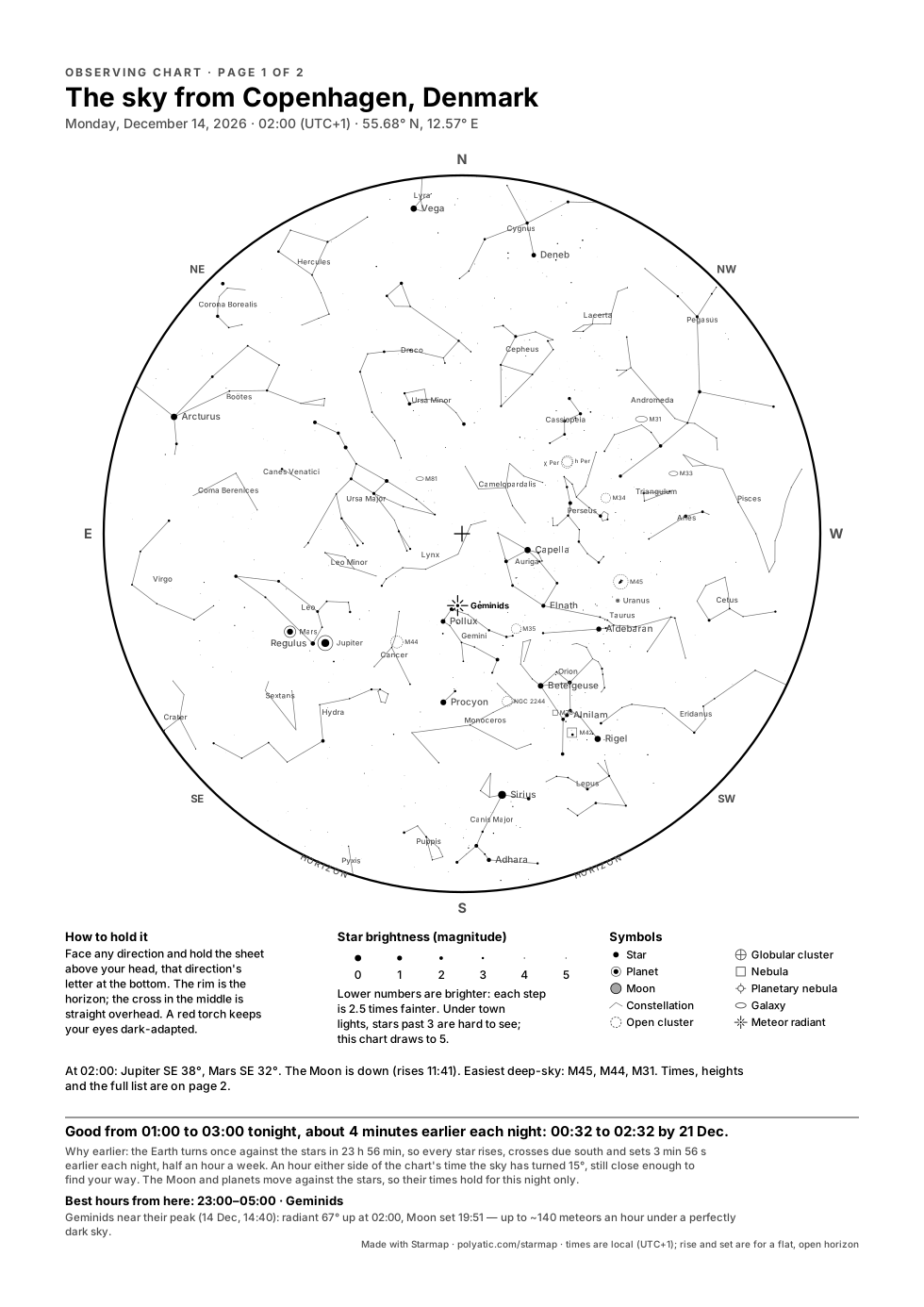
The Geminids of 13/14 December 2026, from Copenhagen
The Geminids are the strongest shower of the year: the International Meteor Organization’s working list gives them a zenithal hourly rate (ZHR) of 150. In 2026 the Earth reaches the peak of the stream at 13:40 Universal Time on 14 December, which is 14:40 on a Copenhagen clock, in daylight. The night that counts is therefore the one before, 13/14 December. That is also what the shower does: Geminid activity climbs for several days and falls off within about a day of the maximum, so the night before a daytime peak is the safer bet than the night after. Seen from Copenhagen that night:
- The radiant, beside Castor in Gemini, comes up at 15:17, before the sky is even dark, and stands highest at 02:06, 67° up in the south.
- The Moon is a 21 % waxing crescent that sets at 19:51, so from mid-evening to dawn there is no moonlight at all.
- The best hour is 02:00: up to about 140 meteors an hour under a perfectly dark sky, about 33 under a typical suburban one.
Other towns get the same shower on different terms. London’s radiant is highest at 01:57, 71° up; New York’s at 01:53, 82° up, with the peak itself at 08:40 local time, after sunrise. From Sydney the radiant does not rise until 22:35 and never gets above 23°, so even a perfect sky there shows at most about 59 an hour. The chart above is the Copenhagen night, printed at 02:00. For this one night worked out for your own town, with the next three Geminid nights, see the Geminids 2026 from your town.
Why the radiant’s height matters
A shower’s meteors all travel in parallel, and seen from the ground their trails point back to one spot, the radiant. When it is low, most of the stream hits the atmosphere over someone else’s horizon. The number you can see scales with the sine of the radiant’s altitude: at 90° you get the full rate, at 67° 92 % of it, at 30° half, at 10° a sixth, and with the radiant below the horizon almost nothing. That is why the bar in each row is low in the evening and tallest around the radiant’s highest point, and why the Perseids are a pre-dawn shower even though their radiant never sets from northern Europe. A radiant’s highest time moves about four minutes earlier each night, the same as any star’s.
Reading a row
- The night is named by both dates, evening and morning. The peak night is the one whose morning carries the peak’s date, unless the peak comes after 16:00 local time, nearer the next evening.
- The bar has one column per hour from 18:00 to 07:00. Its height is the upper bound for that hour, scaled to the night’s own best; dim columns are twilight or day (the Sun less than 12° down), pale ones have a Moon more than half lit above the horizon.
- The best hour is the hour with the highest rate while the Sun is at least 12° below the horizon. On a summer night far north, where it never gets that dark, the row says so.
A dark-sky rate and a town-sky rate
The ZHR is how many meteors one observer would count in an hour with the radiant overhead and stars of magnitude 6.5 visible, a sky darker than almost anyone lives under. Each row gives two numbers: the ZHR times the sine of the radiant’s height (the dark-sky upper bound) and the same divided by r1.5, the IMO’s correction for a sky whose faintest stars are magnitude 5, a fair description of a suburb. Here r is the shower’s own population index from the IMO list: 2.6 for the Geminids, so a quarter of the dark-sky count survives; 2.2 for the Perseids, so about a third. In a city centre, where only magnitude 4 stars show, the Geminids drop to roughly a tenth. Moonlight and cloud are not subtracted; the Moon line tells you when the Moon will cost you meteors.
The year ahead from Copenhagen
From the same town the list holds ten showers. The Orionids peak on the evening of 21 October 2026; their radiant rises at 21:51 and an 82 % Moon sets at 02:48, leaving up to 15 an hour at 06:00. The Quadrantids of 3/4 January 2027 have a ZHR of 80 but a peak only a few hours wide, at 04:20 that morning. The Perseids of 12/13 August 2027 have a radiant that never sets from Copenhagen; an 84 % Moon sets at 00:45 and the best hour is 03:00, up to 85 an hour. The eta Aquariids, a fine shower from Sydney (up to 33 an hour at 05:00 on 7 May 2027), barely clear the horizon from Denmark before dawn.
The chart you take outside
A row’s first link opens the star-map generator’s Observing chart for your town at that night’s best hour, with the shower’s radiant marked: a round chart of the whole sky, black on white, held over your head with the letter of the direction you face at the bottom. It prints on one sheet, with a line saying when the shower is best from your town. The second link makes a poster of the same night with the radiant on it. Don’t stare at the radiant itself: meteors near it are short, and the long ones appear 40° to 60° away from it, so face the darkest part of the sky and look up. The chart and poster draw the 1,630 stars of the Yale Bright Star Catalogue, every one a good naked eye can see, carried to the night’s date by precession. The stars’ own proper motion is not modelled, which over the year this list covers moves none of them by a visible amount. Any date before 15 October 1582 is read in the Julian calendar, should you chart an old shower. The Milky Way is drawn as a soft band under the stars, five steps from its faint edge to its brightest star clouds, and clipped at the horizon like everything else. Its centre line is the galactic equator, computed with the same math as the stars, so it runs where the sky has it: through Cygnus, Aquila and Sagittarius in a northern summer, through Auriga, Gemini and Puppis on a winter night. Its edges and star clouds are a hand-drawn sketch of the naked-eye band, not a traced photograph, so treat them as a guide to where to look, not a brightness map; a checkbox turns the band off. The Moon is drawn at its real altitude, azimuth and phase for your moment, and left off entirely when it was below your horizon. So are the five naked-eye planets: Mercury, Venus, Mars, Jupiter and Saturn are drawn where they stood, sized by how bright each was that night, labelled, and shown only when above your horizon. The Sun is drawn too whenever it was above your horizon, and the line under the chart says whether that moment was daylight, civil, nautical or astronomical twilight, or full dark, with the Sun’s altitude: the stars are always drawn where they stood, even when daylight or twilight hid them. If your moment falls inside a solar or lunar eclipse seen from your place, the eclipse is drawn as well: the Moon over the Sun, to scale, or the Moon in the Earth’s shadow. Uranus, Neptune and 133 deep-sky objects are one switch away: tick Deep-sky objects and the chart marks all 110 Messier objects and 23 southern and binocular showpieces (Omega Centauri, 47 Tucanae, both Magellanic Clouds, the Carina Nebula and more) with star-atlas symbols and labels such as M31 and M42, and adds Uranus and Neptune — open this page’s example with it ticked. Most of them are binocular targets: only a handful, such as M31, M42, M45 and Omega Centauri, show to the naked eye from a dark site, Uranus (about magnitude 5.7) only to a sharp eye, and Neptune (about 7.8) only in binoculars. Great comets since 1900 can be added (Hale-Bopp over London, 1997). Not drawn: faint comets and satellites, whose orbits this tool does not compute.
For the eclipses you can watch from the same town, see every eclipse from your town; for any other night, open the star map generator itself.
Common questions
Will I really see 100 meteors an hour?
Almost certainly not. A figure like 140 an hour is an upper bound for a perfectly dark sky with the radiant overhead. From a suburb expect about a quarter of it, from a city centre about a tenth, fewer still with a bright Moon up, and a single observer misses the meteors behind them. Thirty Geminids in an hour from a garden is a good night.
Why does the radiant’s height matter so much?
Because the count scales with the sine of its altitude. With the radiant 10° up you see about a sixth of what you would with it overhead; below the horizon, almost none. That is why each row gives the radiant’s rising and highest times, and why most showers are best after midnight.
Does the list know if it will be cloudy?
No. Clouds, haze and the weather are not modelled at all, and nor is the glow of your own street. Every rate assumes a clear sky; check a forecast on the day, and the nights either side of the peak are worth trying if the peak night is cloudy.
Where in the sky should I look?
Not straight at the radiant. Meteors appear all over the sky; the longest ones are 40° to 60° from the radiant. Lie back, face the darkest part of the sky, give your eyes twenty minutes without a phone screen, and look up about half-way.
Why is the Geminid night 13/14 December when the peak is on the 14th?
The 2026 peak comes at 13:40 Universal Time on 14 December, daytime in Europe and America. The night that ends on the morning of the 14th is about twelve hours before it, and Geminid rates drop faster after the maximum than they build before it, so that night is the one to choose.
Is anything sent anywhere?
No. The shower list is computed on your own device; the first town is guessed from your time zone’s name only, never from your location, and the town list loads only when you type.
Open the Geminids chart for Copenhagen, 14 December 2026 at 02:00